Strategic Initiative Fund · Established 2026
Understanding how batteries fail — so that they don't
The Battery Safety Testing Lab combines abuse testing, multiphysics modeling, and AI-driven analysis to understand, predict, and prevent battery failure — supporting safer energy storage for vehicles, the grid, and beyond.
- Established 2026 · University Strategic Initiative Fund
- UM-Dearborn · College of Engineering and Computer Science
- Test · Model · Predict
What we do
Safety & Abuse Testing
Controlled thermal, electrical, and mechanical abuse testing of cells and modules in a dedicated safety facility.
Thermal Runaway Modeling
Physics-based simulation of thermal runaway initiation and propagation, from single cells to full packs.
AI for Battery Safety
Machine-learning tools for failure prediction, and a literature-grounded research assistant for thermal runaway science.
Safer Materials & Cells
Next-generation chemistries and interfaces — solid electrolytes and novel anodes — that make cells intrinsically safer.
Latest news
BSTL established with a University Strategic Initiative Fund award
The University of Michigan–Dearborn has awarded a Strategic Initiative Fund grant to establish a battery safety testing laboratory in the College of Engineering and Computer Science, creating a regional capability for abuse testing, failure diagnostics, and predictive modeling of lithium-ion and solid-state cells.
About the Lab
Who we are, why the lab exists, and what we are building.
Our story
The Battery Safety Testing Lab (BSTL) was established in 2026 through a University of Michigan–Dearborn Strategic Initiative Fund (SIF) award, to create a regional hub for battery safety research, testing, and education.
The lab sits in the College of Engineering and Computer Science, in the middle of the metropolitan Detroit vehicle-electrification ecosystem. As cells get larger, denser, and faster-charging, the question that decides whether a design ships is no longer only how much energy it stores — it is how it behaves when something goes wrong. BSTL exists to answer that question with measurement and with models, and to give students, researchers, and regional industry a place to ask it.
Goals
- Test — provide well-instrumented abuse-testing capability to university researchers and to regional industry.
- Understand — couple those experiments with multiphysics models and machine learning to explain and predict failure, not just record it.
- Train — educate the engineers who will design, validate, and certify safe energy storage.
Working with partners
BSTL collaborates across the University of Michigan and with automotive and energy-storage partners in the region. Faculty in mechanical engineering, computational science, and chemistry contribute to the lab's experimental and modeling programs, and simulation work runs on the university's Great Lakes high-performance computing cluster.
Support
BSTL is established with support from a University of Michigan–Dearborn Strategic Initiative Fund award (2026).
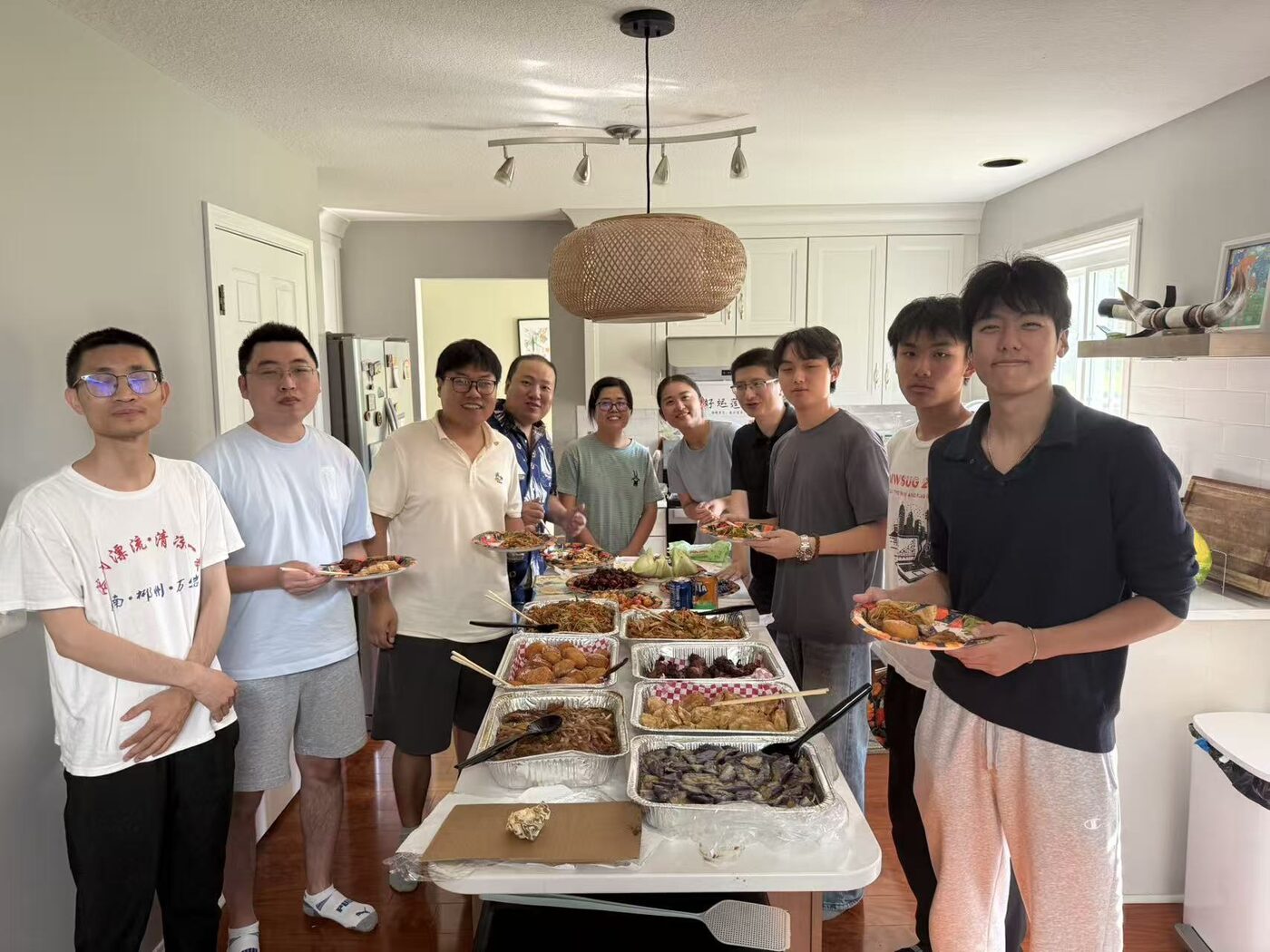
img/group-outdoor.jpg is the stronger group shot but
includes a child — do not publish it without parental consent. Also add the official SIF
award title/number to the Support block once Dr. Chen supplies it.Research
Four connected thrusts, from cell-level failure physics to the AI tools that accelerate safety science.
Thrust 1 · Safety and abuse testing
Experiment
Controlled abuse experiments — thermal (external heating, oven exposure), electrical (overcharge, external short circuit), and mechanical (nail penetration, crush) — instrumented to capture failure onset, vent behavior, and propagation. The facility is being designed with reference to the standard abuse-test procedures used in automotive and transport qualification, including the SAE J2464 and UL 2580 families and UN 38.3, so that results are directly comparable to the tests partners already run.
Thrust 2 · Thermal runaway modeling and simulation
Simulation
Multiphysics models of thermal runaway initiation and cell-to-cell propagation, validated against lab experiments and used to inform pack-level safety design. Current work couples electrochemical and thermal physics around internal short circuits — both the abrupt "hard" short and the slow, partial "soft" short that precedes many field failures — to predict when local heating tips a cell into self-sustaining runaway. Models are built in COMSOL Multiphysics alongside in-house solvers, and resolved down to the microstructure where the heat is actually generated.
Thrust 3 · AI for battery safety
Computation
Machine-learning approaches to failure prediction, data-driven analysis of abuse-test data, and research tools that make the thermal runaway literature computable. Surrogate models trained on simulation output let designers screen geometries and operating windows in seconds rather than CPU-days.
ThermalRunawayAI — a research assistant for thermal runaway science
A literature-grounded AI assistant built in the group: hybrid retrieval over a curated corpus of battery-safety publications, figure and table understanding, and answers that cite their sources. Built with student researchers, it is aimed at the questions where general-purpose chatbots fail — buried numbers, correct rankings, and primary citations. A hosted, login-restricted deployment is planned.
Thrust 4 · Safer materials and next-generation cells
Materials
Materials-level routes to intrinsic safety. Work in this thrust includes garnet (LLZO) solid electrolytes — where lithium dendrites penetrating along grain boundaries create the soft shorts that limit usable current density — and room-temperature liquid-metal gallium–indium anodes, where the phases that form during lithiation govern how the electrode survives fast charging. Phase-field and transport models developed in the group link microstructure to the electrical signature a cell actually shows.
Computational infrastructure
The lab develops and maintains its own simulation stack — a phase-field solver for microstructure evolution, coupled electrochemical–transport models, and machine-learning surrogates — and runs production campaigns on the University of Michigan's Great Lakes high-performance computing cluster, alongside licensed COMSOL Multiphysics.
Facilities & Capabilities
What BSTL can do today, and what is being installed under the 2026 Strategic Initiative Fund award.
| Capability | What it supports | Status |
|---|---|---|
| Thermal abuse & calorimetry | External heating and oven exposure; self-heating onset and heat-release characterization of cells. | Being established |
| Electrical abuse | Overcharge, over-discharge, and external short-circuit testing with controlled cycling. | Being established |
| Mechanical abuse | Nail penetration and crush, for internal-short-circuit initiation studies. | Being established |
| Failure diagnostics | High-speed and infrared imaging, distributed temperature measurement, and vent-gas analysis during abuse events. | Being established |
| Multiphysics simulation | Electrochemical–thermal and phase-field modeling of cells, shorts, and propagation; COMSOL Multiphysics plus in-house solvers. | Available now |
| High-performance computing | Large simulation campaigns and machine-learning training on the U-M Great Lakes cluster. | Available now |
Instrument specifications and cell formats will be published here as equipment is commissioned through 2026–27.
Work with us
BSTL welcomes inquiries from companies and research groups who need abuse testing, failure analysis, or predictive modeling of cells and modules — including joint projects, sponsored testing, and student capstone collaborations. Write to leichn@umich.edu to discuss what you need.
People
The faculty, researchers, and students behind BSTL.
Faculty
Lei Chen, Ph.D.
Director · Associate Professor, Mechanical Engineering
Leads the lab's research program in battery safety and computational materials science, with a focus on phase-field and multiphysics modeling of degradation and failure in lithium-ion and solid-state cells.
Oleg Zikanov, Ph.D.
Co-Investigator · Professor and Chair, Mechanical Engineering
Works in computational fluid dynamics and heat transfer, bringing large-scale transport simulation to the lab's thermal modeling of cells and packs.
Dohoy Jung, Ph.D.
Co-Investigator · Mechanical Engineering
Works on thermal management and energy systems for vehicles, connecting cell-level safety behavior to pack and vehicle thermal design.
dohoy@umich.edu. A researcher named Dohoy Jung
publishes on vehicle thermal management and battery-pack cooling (including a Journal of Power
Sources paper on battery cell arrangement and heat-transfer fluids) and carries a
“Department of Mechanical Engineering, University of Michigan–Dearborn, 4901 Evergreen
Road” affiliation in the publisher record — so the identification and the research fit are
well supported. But there is no umdearborn.edu faculty profile page at any slug
tried, so his academic rank could not be confirmed; the card deliberately says only
“Mechanical Engineering” rather than asserting a title. Dr. Chen still needs to
confirm the name, rank, and SIF role before launch, and add the profile link. The other two
faculty titles are taken verbatim from their live UM-Dearborn profiles (Chen: Associate Professor;
Zikanov: Professor and Chair) and both names now link to those pages. Each faculty member should
approve their own bio.Researchers and students
Rui Wang, Ph.D.
Postdoctoral Research Fellow
Multiscale modeling of battery failure — phase-field simulation of dendrite growth, electrochemical transport in solid electrolytes, and machine-learning surrogates for safety prediction.
Jinrong Su
Graduate Researcher
Coupled hard and soft internal-short-circuit modeling of thermal runaway, and engineering strategies to suppress runaway propagation in lithium-ion packs.
Student researchers
Graduate and undergraduate contributors
Students contribute across the lab's experimental, modeling, and software work, including the development of the group's AI research assistant.
Join the lab
Open to prospective students
We are recruiting graduate and undergraduate researchers interested in battery safety, multiphysics modeling, and scientific machine learning. Get in touch →
Publications
Selected work on battery safety, failure modeling, and materials from the BSTL team.
Battery safety, failure, and dendrite modeling
Materials modeling and high-temperature degradation
Team members are shown in bold. This page lists peer-reviewed work that has appeared in press; manuscripts under review are added once accepted.
Find our work
Every entry above links to its publisher record. Complete and current publication lists for individual team members are available on their faculty profile pages.
News
Announcements, milestones, and outreach. Newest first.
BSTL established with a University Strategic Initiative Fund award
The University of Michigan–Dearborn has awarded a Strategic Initiative Fund grant to establish a battery safety testing laboratory in the College of Engineering and Computer Science, creating a regional capability for abuse testing, failure diagnostics, and predictive modeling of lithium-ion and solid-state cells.
Group demonstrates an AI research assistant for thermal runaway literature
Student researchers in the group demonstrated ThermalRunawayAI, a retrieval-based assistant that answers battery-safety questions with citations drawn from a curated publication corpus, including figures and tables that general-purpose chatbots typically miss.
Thermal runaway modeling work presented to regional automotive partners
The group presented its microstructure-resolved modeling of internal short circuits and thermal runaway to engineering partners in the regional vehicle-electrification industry.
Contact
For research collaboration, testing inquiries, or student opportunities.
Lab director
Lei Chen, Ph.D.
Director, Battery Safety Testing Lab
leichn@umich.edu
Visit
Battery Safety Testing Lab
College of Engineering and Computer Science
University of Michigan–Dearborn
4901 Evergreen Road
Dearborn, MI 48128
Industry & collaboration
Companies and research groups interested in abuse testing, failure analysis, or joint modeling projects are welcome to get in touch with the lab director.
Prospective students
Graduate and undergraduate students interested in battery safety, multiphysics modeling, or scientific machine learning should contact the lab director with a CV and a short statement of interest.
Site
Questions about this website: Rui Wang, wangrz@umich.edu.